The Unchased Blade — The Lithic Heart of Qi Baishi officially opens on Oct. 232026-11-02
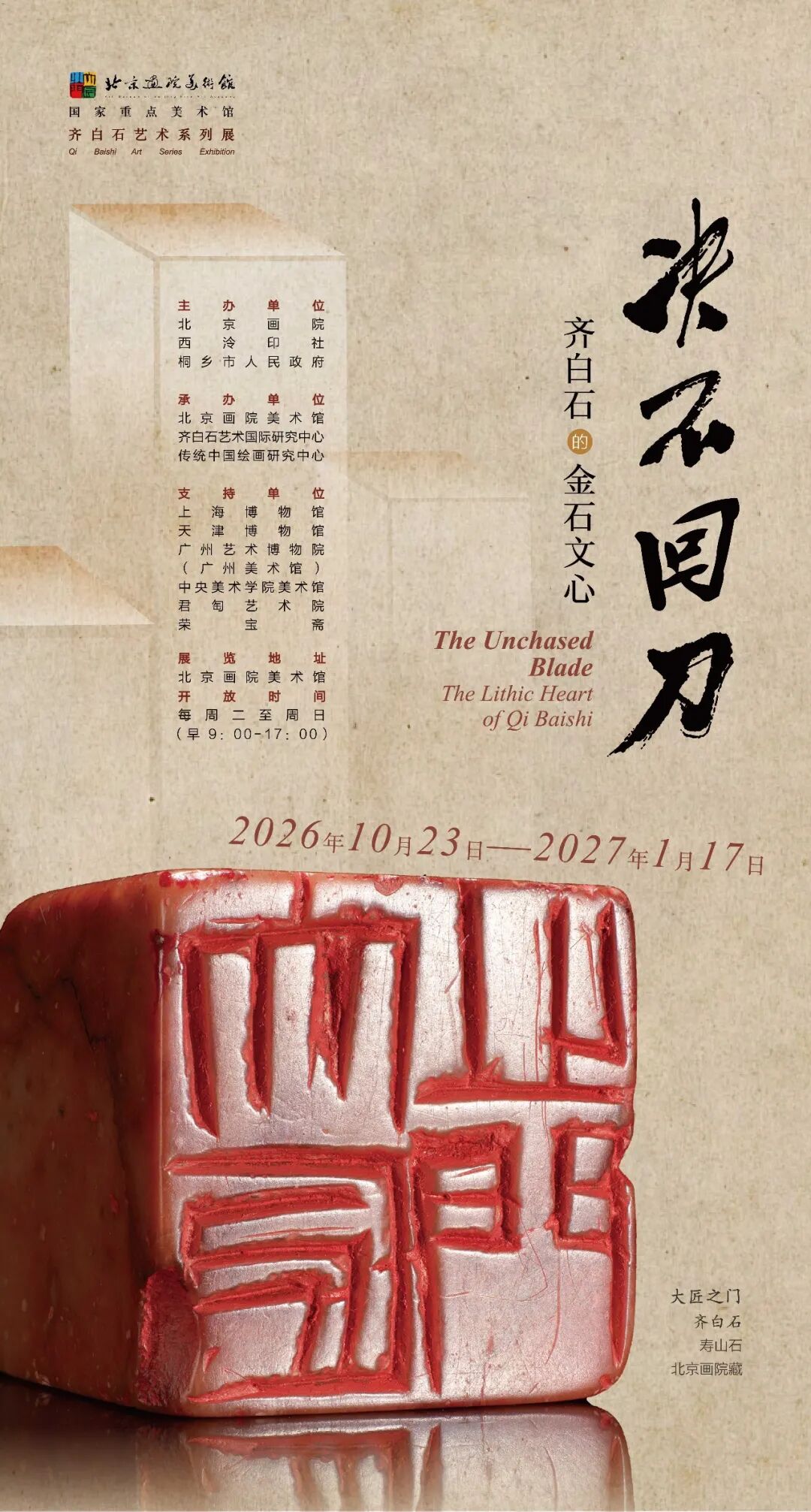
Exhibition Poster
"Once the blade goes down, it never retreats."
This is the resolute seal-carving maxim uttered by Qi Baishi (1864-1957) — a technical annotation of his single-blade direct-carving method, an aesthetic declaration free of embellishment, and a life philosophy of moving forward without hesitation.
On October 23, 2026, the exhibition "The Unchased Blade — The Lithic Heart of Qi Baishi," jointly hosted by Beijing Fine Art Academy, Xiling Seal Engraver's Society, and Tongxiang Municipal People's Government, opened at the Art Museum of Beijing Fine Art Academy. The exhibition brings together collections from domestic major cultural and museum institutions, including Shanghai Museum, Tianjin Museum, Guangzhou Museum of Art, CAFA Art Museum, Juntao Art Museum, and Rong Bao Zhai. Centering on Qi Baishi's seal carving art, it gathers over 220 seal carvings, paintings, and calligraphic works spanning from the Qin (221BC-207BC) and Han (202BC-AD220) dynasties to the 20th century. Through four sections — "First Approach to the Seal Art," "Tracing the Seal Lineage," "Carving out a Path with a Blade," and "Shaping the Heart with a Knife" — it systematically traces the millennia-long development and stylistic evolution of China's literati seal carving.
I. A cross-era dialogue on the seal lineage to echo an exhibition 14 years ago
In 2012, Beijing Fine Art Academy presented the exhibition "An Affluent Artist with 300 Seals — Qi Baishi's Seal Carving Heart," the first systematic display of the academy's collection of three hundred seals by Qi Baishis, answering the question "What did Qi Baishi carve?" Few know that the original proposed name for that exhibition was precisely "The Unchased Blade," later renamed as aforementioned to suit the positioning of a collection exhibition.
Fourteen years later, the revival of "The Unchased Blade" is not a repetition but a response — this time, we attempt to answer "Why did Qi Baishi carve the way he did?" The exhibition seeks to re-anchor Qi Baishi's historical position in the modern seal-carving world: dispelling both the prejudicial label of "wild fox Zen (unprofessionalism)" and the romantic view of "pure genius," it re-examines the artist within the orthodox lineage of literati seal carving while arguing that his originality was a stylistic revolution with deep roots.
To this end, the exhibition brings together masterpieces of Ming (1368-1644) and Qing (1636-1912) seal carving, including Ding Jing's "Shut the Door and Read for Months, Climb the Mountain and Gaze at the Water Until Sunset" and "Zhu Pingzi (Bamboo Screen)," Huang Yi's "Sell Paintings to Buy a Mountain" and "One Character Worth a Hundred Gold," Zhao Zhiqian's "I Wish I Could Not Grieve, But I Cannot Help It" and "May You Live as Long as Metal and Stone, Fine and Good," Huang Shiling's "Jiang Qigong's Long Life and Prosperity for Descendants" and "Shi Shi's Seal of Trust and Longevity," and Wu Changshuo's "Shen Boyun's Collection of Metal, Stone, Calligraphy, and Painting" and "Renhe Gao Yong's Seal." Qi Baishi's works imitating the Zhejiang School and Zhao Zhiqian are displayed alongside them. From Ding Jing's archaic and vigorous cutting style, to Zhao Zhiqian's seeking aesthetics beyond seals, and then to Qi Baishi's single-blade breakthrough — visitors can directly experience Qi Baishi's orthodox foundation in learning from the ancients, and glimpse the vast, surging spirit of China's thousand-year seal-carving tradition.
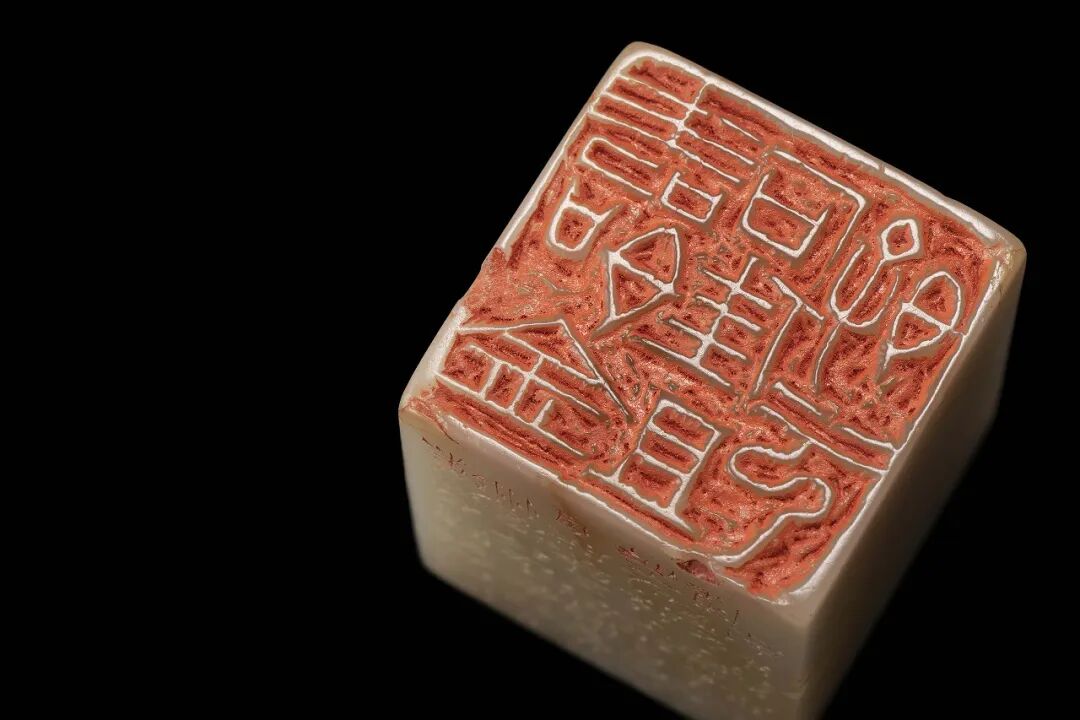
May You Live as Long as Metal and Stone, Fine and Good
Zhao Zhiqian, relief seal, 3.1 × 3.1 × 4 cm, Qing Dynasty, Shoushan stone
Collection of the Juntao Art Museum
The phrase "May You Live as Long as Metal and Stone, Fine and Good" is taken from the Han Dynasty's mirror inscription of "Mirror for Long Prosperity of Descendants," a common motif in literati seal carving. The seal's characters combine the archaic elegance of seal script with the brushstrokes of clerical script; the lines are upright and polished, possessing the extensibility and antique simplicity of metal and stone works. This seal both reveres ancient methods and demonstrates strong innovation, exerting a profound influence on later masters such as Wu Changshuo and Qi Baishi.
II. Standing firm by the blade: how a veteran "Beijing drifter" broke through the seal world
After arriving in Beijing in the early 1920s, Qi Baishi established himself on a carving knife at the beginning. While the painting circle had yet to fully embrace the newcomer, his seal carving had already commanded the highest honorarium in the capital. Alongside market recognition came criticism from the mainstream seal-carving world — heterodox, "wild fox Zen," insufficient archaism, crude technique...
This exhibition uses Qi's four honorarium schedules spanning 1903 to 1948 to thread his life trajectory from "establishing himself" to "becoming a master" through the rise and fall of his remuneration. Through horizontal comparison with other seal carvers of his time, it presents the unique value of Qi's seal-carving art. The gallery features a special "My Way Is My Own" controversy wall that juxtaposes contemporary critiques with Qi's own statements, illustrating the clash between tradition and innovation head-on. Actually, the invisible hand of the market had already given its most straightforward response to the rivalry in the most plainspoken way.
Qi Baishi's establishment through seal carving relied not only on his distinctive style but also on the support of his circle of friends. The exhibition features seals Qi carved for figures from various circles, including Tan Yankai, Yang Zhaojun, Hu Egong, Zhu Qizhan, Yang Du, and Fan Zengxiang — the aesthetic choices of orthodox literati, rising political figures, and new-school scholars together elevated Qi's standing in the seal world. The concentrated display of his mature seals from the 1930s, such as "Even My Ox Will Not Drink the Water That Washes Your Ears" and "Lovers Across Flowers Seem Farther Than the Horizon," allows visitors to concretely perceive the single-blade charm of "the unchased blade." The exhibition also juxtaposes Qi Baishi's seal carvings with the original paintings and calligraphy bearing those seal impressions, fully revealing the traditional literati aesthetic of "poetry as the conception of paintings, seals as the expression of the heart."
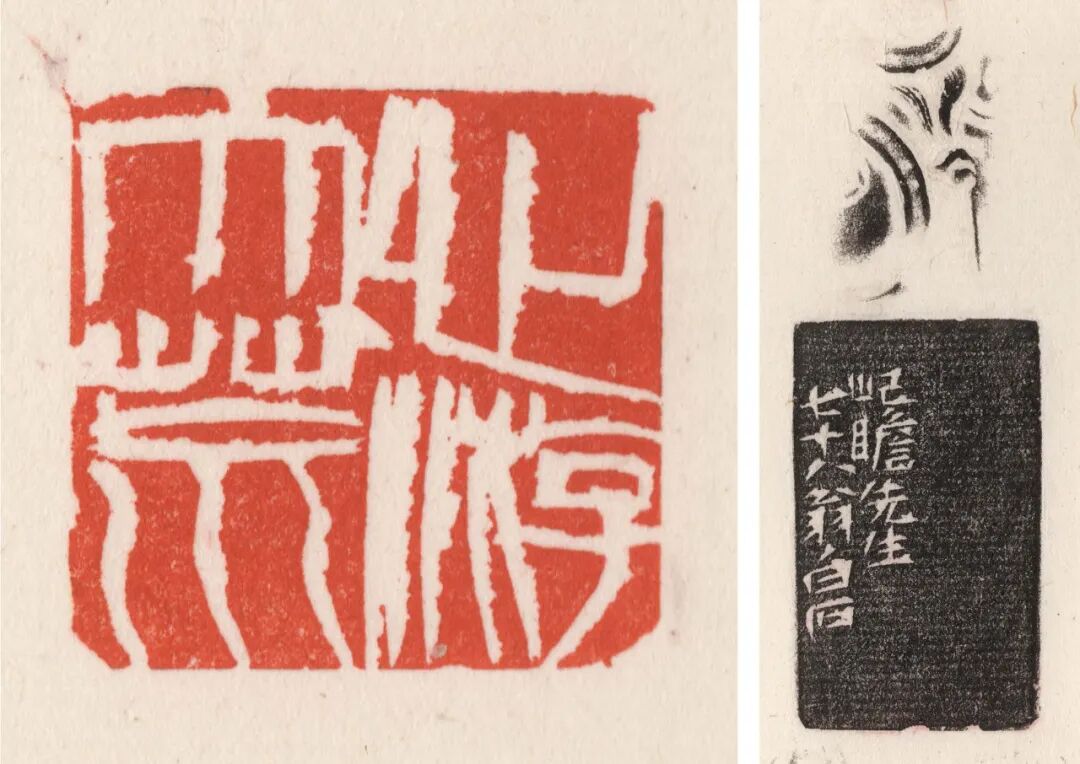
The Heart Wanders the Great Wilderness
Qi Baishi, intaglio seal, 2.48 × 2.5 × 8.34 cm, 1938, Shoushan stone
Donated by Zhu Qizhan and his wife Chen Ruijun, collection of the Shanghai Museum
This seal, carved by Qi Baishi for Zhu Qizhan, stands as a testament to their friendship. Qi placed great importance on the seals he carved for Zhu. Zhang Zengtai recollected that "(Qi Baishi) always made the wooden case and wrote the name and address himself. He never entrusted it to others for the mails to Zhu." This seal was created after Qi's late-life transformation, when his seal-script rounded strokes changed to square strokes — vertical and horizontal, flat and straight, entirely natural, already possessing the signature look of "Qi's seal style."
III. Observing the heart in a square inch: a tangible gathering of refined seal works
Poetry expresses aspiration, painting takes form, and seals preserve the heart. The integration of poetry, calligraphy, painting, and seals is the highest pursuit of China's literati art and the complete foundation of Qi Baishi's art — his poetry is sincere and plain, his calligraphy weighty and unadorned, his seals flat and vigorous, all resonating in form and spirit with the vivid flowers and trees and lively insects and grasses beneath his brush.
The exhibition bridges the boundary between the professional and the public through diverse formats: electronic screens, high-definition images, and textual explanations deconstruct the aesthetic characteristics of different carving methods and popularize seal-impression conventions through the ages; a stamp-and-check-in area gives visitors a hands-on experience of seal impressions and take home their own square-inch memory; a rest area features a tracing experience zone for the Two Golden Butterflies Hall Seal Manual, following the old path of Master Qi Baishi to experience the scholarly approach of tracing seal manuals and understand the foundation of studying the ancients behind "the unchased blade"; and there is a full-process demonstration of Qi's seal carving, from drafting and transferring to the stone, to carving and impressing — presenting the complete birth process of a seal. More details and surprises await visitors to discover themselves.
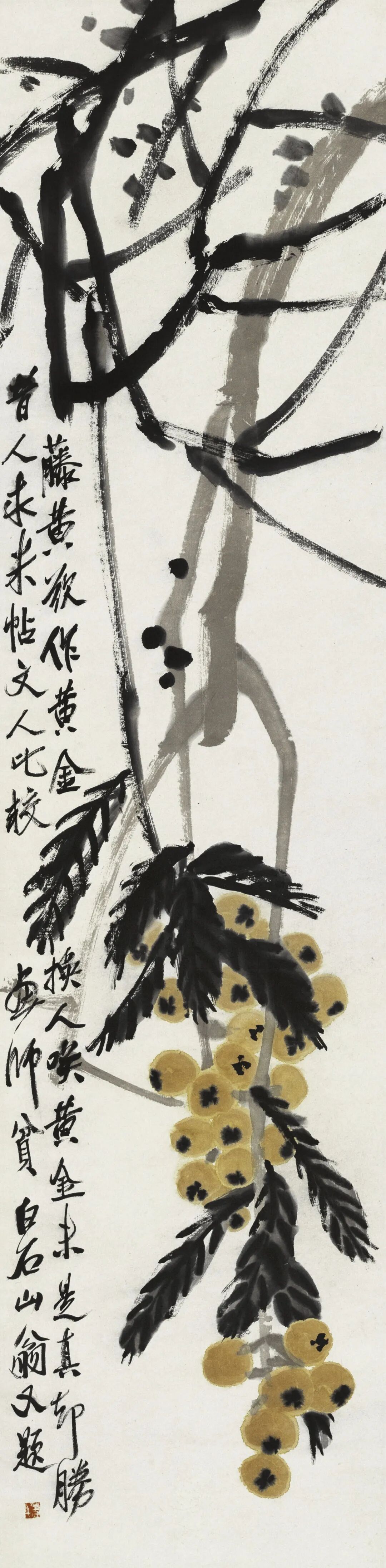
Loquat
Qi Baishi, 138.5 × 34 cm, undated, ink and color on paper
Collection of the Beijing Fine Art Academy
Qi Baishi paints loquat fruits using the boneless technique with gamboge yellow, which appear even more lustrous and vivid against the ink leaves and branches. The painter's inscription poem remains humorous as ever — he compares the loquats painted with gamboge yellow to gold, hoping to exchange them for real gold, yet unable to win the world's recognition; he compares his act of selling paintings to the letter by Tang Dynasty calligrapher Yan Zhenqing requesting rice, feeling that he is neither better nor worse off — revealing a relaxed, contented state of mind.
Seal carving is so small that one must lean in and hold one's breath to see it clearly; yet seal carving is also so heavy that behind every cut lies several thousand years of tradition.
More than a century ago, an outsider newly arrived in Beijing, using the knife as his brush and the stone as his paper, commanded the highest seal-carving honorarium in the capital. On what grounds? By his blade, by his stubbornness, by that spirit of never retreating the blade. Today, a century later, standing before these seals, we can still hear the crisp sound of stone chips breaking away, still feel the force of the blade moving across the stone — crisp, fast, without hesitation.
The eternal moonlight once shined on the bronze seals of Qin and Han and the stone seals of Ming and Qing alike, and now falls gently on the desk where Master Qi Baishi wielded his knife. The cultural lineage surges like a tide, rushing forth from the depths of time, endless and unceasing — with the sharp edge of a blade that never retreats, he established a height all his own at the crest of the wave.
Moonlight shines on the square inch; the tide resounds for thousands of years. The blade marks on the stone will not fade — just as the Master Qi's literary heart and courage remain forever clear and bright.
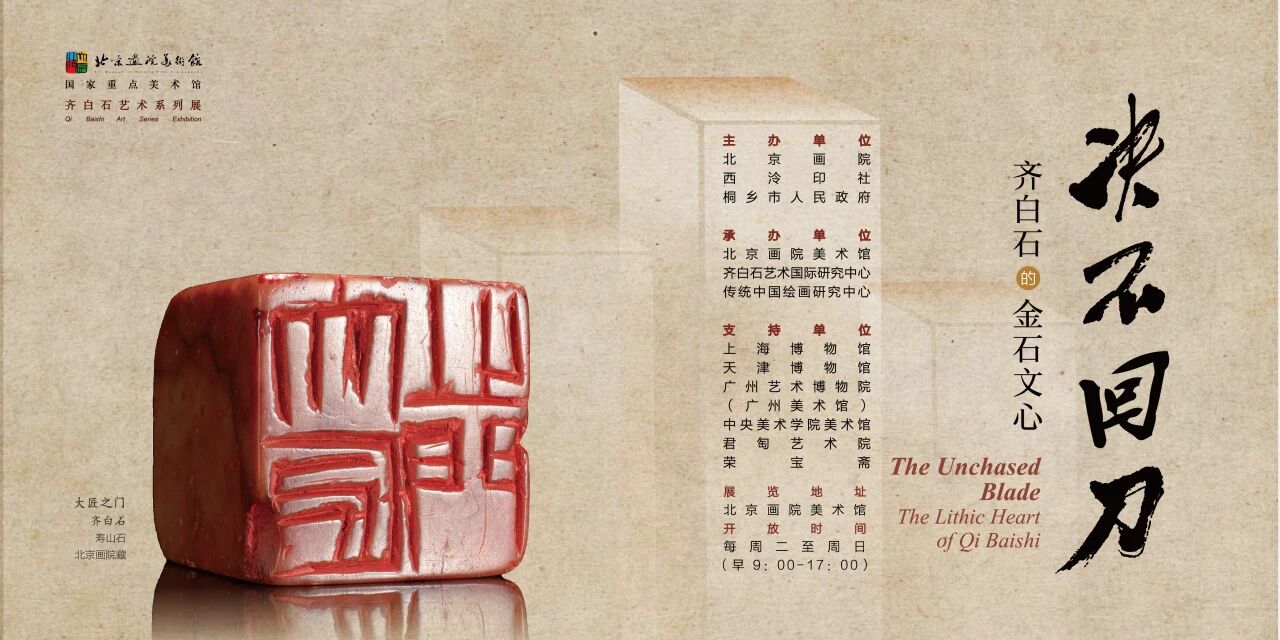
Title: The Unchased Blade — The Lithic Heart of Qi Baishi
Duration: October 23, 2026 – January 17, 2027
Hosted by: Beijing Fine Art Academy, Xiling Seal Engraver's Society, Tongxiang Municipal People's Government
Organized by: Art Museum of Beijing Fine Art Academy, Qi Baishi International Research Center, Traditional Chinese Painting Research Center
Supported by: Shanghai Museum, Tianjin Museum, Guangzhou Museum of Art, CAFA Art Museum, Juntao Art Academy, Rong Bao Zhai
Venue: 1/F–4F, Art Museum of Beijing Fine Art Academy