Who is sending a letter far through clouds? — The artistic world within decorated letter paper
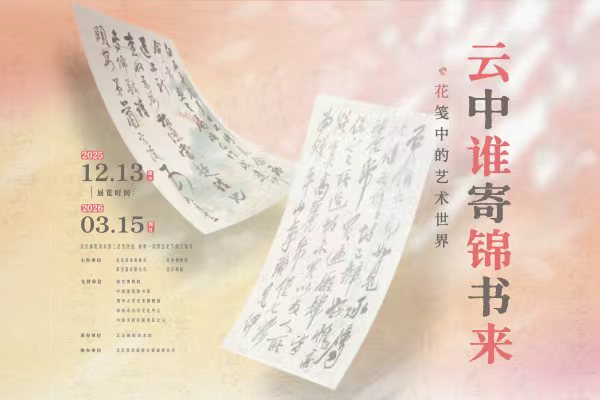
- show time:2025-12-13 to 2026-03-15
- Organizer:Beijing Artists Association, Suzhou Museum, Rong Bao Zhai Co., Ltd., Beijing Fine Art Academy
- venue:Venue: F3 and F4, Art Museum of Beijing Fine Art Academy
China's culture of decorated letter paper (or huaqian, floral letter paper literally) boasts a long and profound history. Within the compact space of a single sheet lies not only the crystallized wisdom of ancient Chinese papermaking, engraving, and printing techniques, but also the aesthetic tastes and spiritual pursuits of historical literati across dynasties. The exhibition "Who is sending a letter far through clouds? — The artistic world within decorated letter paper" was scheduled to open on December 13, 2025 at the Art Museum of Beijing Fine Art Academy, inviting visitors into the gorgeous, connotative, and sentimental world of letter paper.
A gathering of treasured collections: Showcasing millennial elegance
Co-organized by the Beijing Artists Association, Suzhou Museum, Rong Bao Zhai Co., Ltd., and Beijing Fine Art Academy, with generous support from the Palace Museum, National Library of China, Tsinghua University Art Museum, Suzhou Municipal Center of Public Culture and Cathay Bookshop Co., Ltd., the exhibition brings together over a hundred precious artifacts from eight cultural institutions. The exhibits include rare letter papers, letter paper albums, correspondences, letter paper paintings, and engraved woodblocks, systematically tracing the evolution of Chinese letter paper dating back to the Tang, Song, Yuan, Ming, Qing dynasties and the Republic of China. Through three thematic sections—Gorgeous colors, Subtle shadows of flowers, and Love conveyed through letters—the exhibition delves into the intrinsic connection between the artistic development of Chinese letter paper and the spirit of historical literati.
.jpg)
Plum blossom-patterned jade-block paper, during the reign of Emperor Qianlong, Qing Dynasty
49.1cm × 51.3cm, collected by the Palace Museum
Tracing the history of elegant letter paper: Recreating the pinnacle of woodblock watermarking
The evolution of Chinese letter paper is not only a chronicle of printing technology but also a testament to the literati's conscious pursuit of beauty across dynasties. The exhibition vividly outlines the millennial history of Chinese letter paper from simplicity to splendor. It traces the trend of private papermaking initiated by Tang poetess Xue Tao with her titular "Xuetao Paper" to the refined varieties like embossed paper appeared during the Song and Yuan dynasties. Among the exhibits, the Ornamental Letter paper from the Ten Bamboo Studio printed in the 17th year under the reign of Emperor Chongzhen of the Ming Dynasty stands out. Utilizing classic techniques such as douban (splitting a block) and gonghua (embossing and debossing), the masterpiece achieved color gradients and richly layered imagery through repeated overprinting with multiple blocks, representing the pinnacle of woodblock watermarking. Lavish and intricate works like the Qing court collection "Plum blossom-patterned jade-block paper" and "Pink wax paper imitating Mingren Hall's design of gold ruyi and cloud patterns" are also featured. The exhibition highlights the Beiping Letter Paper Album, co-edited by Lu Xun and Zheng Zhenduo, hailed as "the sole monumental work marking an era in the history of Chinese woodblock printing."
.jpg)
Ornamental Letter paper from the Ten Bamboo Studio , First Volume, during the reign of Emperor Chongzhen, Ming Dynasty
27.1cm × 17.2cm, Collected by the National Library of China
.jpg)
Beiping Letter Paper Album (No. 7), 1933, This letter paper was painted by Chen Shizeng.
32cm × 22cm, Collected by Cathay Bookshop
.jpg)
Luoxuan Biangu Letter Paper Album, 1981, "Zeqi" Letter Paper
32cm × 21cm, Collected by Suzhou Municipal Center of Public Culture
Reviving traditional craftsmanship: Interpreting the ingenuity in a compact space
To allow visitors to directly appreciate the craftsmanship contained in the letter paper, the exhibition features a dedicated display area showcasing techniques such as gonghua, douban, yahua (embossing), sajin (sprinkling golden powder), and nijin (applying golden paste). Through demonstration videos, tools, and engraved woodblocks, the subtlety of embossing, the brilliance of golden powder, the serenity of golden paste, the vibrancy of split-block printing, and the restraint of embossing and debossing printing are vividly brought to life, embodying the wisdom of Chinese artisans. Visitors are also encouraged to touch these paper pieces, feeling the tangible artistic heritage.
Additionally, original letter paper paintings by literati-artists of the Republic of China era, such as Qi Baishi, Zhang Daqian, Yan Bolong, Ma Jin, and Chen Yuandu, are also on display. Thanks to their creations, letter paper evolved into an art form integrating painting, calligraphy, sculpture, and printing. The exhibition clearly demonstrates that the letter paper designs required both artistic conception and brushwork charm, as well as suitability for printing and publication, achieving a perfect integration of practicality, aesthetics, functionality and form.
.jpg)
Qi Baishi's Drawing No. 23, 1936
28.2cm × 17.5cm, Collected by Rong Bao Zhai Co.,Ltd.
.jpg)
Beijing Rong Bao Zhai New Poetic Letter Paper Album, 1955, "Kingfisher" Letter Paper
31.2cm × 21.5cm, Collected by Beijing Fine Art Academy
Seeing a letter is like meeting its writer: Emotional warmth of literati in letter paper
"May this letter find you well. Seeing your letter is like meeting you." Letters are not merely a medium of communication but also vessels of emotion. The exhibition features correspondences of late Qing dignitary Pan Zuyin sent to masters like Wu Changshuo, Shen Shuyong, and Zhao Zhiqian. Also on display are the precious Futang Family Letters by Yao Mangfu, the "polymath of his time," who used letter paper adorned with his collected epigraphic designs to convey encouragement to his son. Letters written by Qi Baishi to his disciple Yao Shiqian on paper he painted in imitation of Bada Shanren's style, as well as warm correspondences between Qi Baishi and other literati of the era, form "Qi Baishi's Circle of Friends on Letter Paper." The exhibition also highlights the touching story of Lu Xun using loquat and lotus seedpod-patterned paper to convey affection to his wife Xu Guangping. Each sheet and image, every word and sentiment, reveals the inner world and character of the literati.
At the end of the exhibition, the interactive installation "a letter from you" invites visitors to write a letter, which is to be exhibited on the hall, put into the mailbox, or taken away, serving as an emotional bridge across time and space.
.jpg)
Qing Dynasty's Correspondence Album, Pan Zuyin, Collected by Suzhou Museum
.jpg)
Futang Family Letters, Yao Mangfu
28.5cm × 20.5cm, Collected by Tsinghua University Art Museum
.jpg)
Letters of Binweng (A letter to Yao Shiqian), 1933, Qi Baishi
37cm × 38.5cm, Collected by Beijing Fine Art Academy
Beijing Fine Art Academy has long been dedicated to the study and promotion of traditional Chinese painting and calligraphy, gradually expanding its research breadth and depth in recent years. This comprehensive exhibition on letter paper, integrating artistry, scholarship, craftsmanship, and public education, is a testament to these efforts. The exhibition's title, "Who is sending a letter far through clouds" is quoted from Li Qingzhao's lyric A Twig of Plum Blossoms: The fragrance of lotus fades away, the jade mat hints an autumn day:
Who is sending a letter far through clouds?
When wild geese with message return in line,
My west chamber will be drenched in moonshine.
These lines express the sincere longing of the poetess Li Qingzhao for her husband Zhao Mingcheng during their separation. Such enduring emotional expression, however, has gradually faded in today's world dominated by instant communication. It is hoped that this exhibition will enable visitors to pause beside these serene and beautiful sheets of paper and feel the warmth of emotions that transcend time and space, contained within their modest dimensions.
During the exhibition, Beijing Fine Art Academy will also host a variety of public education activities, such as papermaking and letter-writing workshops, and woodblock watermarking experiences, ushering the public deeper into the artistic and cultural world of "letter paper" and revitalizing traditional culture through hands-on activities.
The exhibition opened to the public at the Beijing Fine Art Academy Art Museum on December 13, 2025, and will run until March 15, 2026.
Works Picture
-
Plum blossom-patterned jade-bl...
-
Ornamental Letter paper from t...
-
Beiping Letter Paper Album (No...
-
Luoxuan Biangu Letter Paper A...
-
Qi Baishi's Drawing No. 2...
-
Beijing Rong Bao Zhai New Poet...
-
Qing Dynasty's Correspond...
-
Futang Family Letters
-
Letters of Binweng (A letter ...